
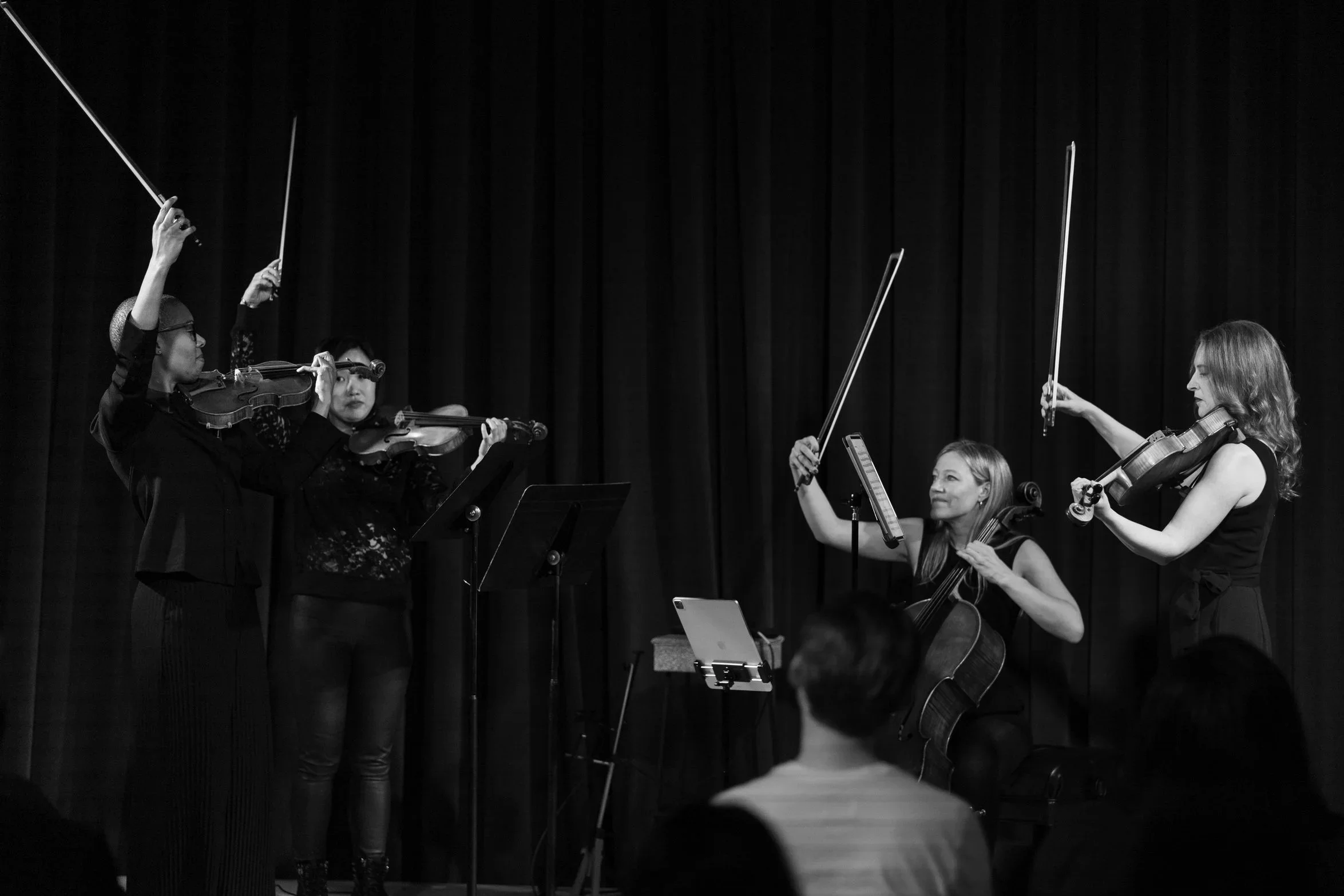
The Overlook
photo by Sean Davis

Formed during the pandemic to build community through music, the ensemble is committed to amplifying the voices of living composers and engaging audiences through performances that make contemporary chamber music both accessible and deeply compelling.
Album Artwork by Forbes Graham

Trevor Weston opens the album with Juba, which honors the lives of enslaved African and African American crop laborers, and which sources its musical materials from each culture’s folk traditions. (The Overlook have played the work often enough that Weston ultimately rededicated it to them.) At various moments, foot-stomping, quick glissandi, and wide vibrato invoke folk fiddle and vocal stylings. Darting between mischief and lyricism, the work transmutes its historical grounding into a style all Weston’s own.
LISTEN:








The album’s single commission, Shanan Estreicher’s I Laughed So Hard I Cried (for Judee Sill), emerged from “Overlooked No More,” a project with the podcast Relevant Tones that is named for the New York Times's obituary series, which is devoted to figures who had not received their historical due at the time of their parting. Sill, an American singer-songwriter who went largely unrecognized during her time in the ‘70s folk rock scene, but has gained posthumous recognition over the last decade, is not referenced directly here, other than in the lyric from which Estreicher derived the title. Rather, the work conveys her music’s essence, in songlike melodies and contrapuntal passages that hint at her love of J.S. Bach.

Shelley Washington’s Say announces itself, quite literally, with The Overlook’s members snapping, clapping, and singing the titular couplet: “Say it loud / Say it low / Sing it fast / Sing it slow.” Soon these exhortations find counterparts in the quartet’s instrumental playing, which echoes the lyrics’ rhythm and spiky, empowered sensibility. Inspired by the composer’s reflections on her own Black-white biracial identity, Say is at once introspective and uninhibited, addressing self and world in the same beat. For their discovery of the work, The Overlook has the composer’s mother to thank: following Metcalf’s performance of another Washington work, the senior Washington mentioned that she might consider playing another work that few other groups had attempted.

A 2021 performance at the Hispanic Society introduced the group to Leila Adu-Gilmore’s “if the stars align…”, written originally for the Brentano String Quartet. Told after a performance by the Brentano’s violist that she’d write for the group “if the stars aligned,” Adu-Gilmore decided to compose a quartet with the cosmos in mind, uniting sparkling airy textures and angular phrases. The Overlook’s violist, Angela Pickett, delivers the centerpiece, a ferocious few minutes of rolling chords that leave no doubts about her instrument being the work’s main character.

Forbes Graham’s Crossing reached The Overlook via one of the group’s Instagram open calls for unplayed work, and has become amongst their most beloved offerings. Described by the composer as “a study in probabilities” predicated on “a combination of three cosine functions,” the work employs a catalogue of strident themes, forceful pizzicati, and airy choruses, managing all in the short span of four minutes. Crossing’s premiere at Mass MoCA, as part of a collaboration with sculpture artist Linda Sormin, marked the first in-person meeting between Graham and The Overlook after a long collaborative stretch.
Carlos Simon’s Warmth from Other Suns is named for Pulitzer Prize winning journalist Isabel Wilkerson’s book The Warmth of Other Suns, a study of the Great Migration, in which six million African Americans left the South for the East and West in search of economic, social, and educational opportunities. Simon channels the text’s overarching themes of hope, transit, and arrival across three movements: the inward, exploratory “Rays of Light”; then the fiddly, perpetual-motion “Flight”; and, to conclude, the calm and reflective “Settle.”
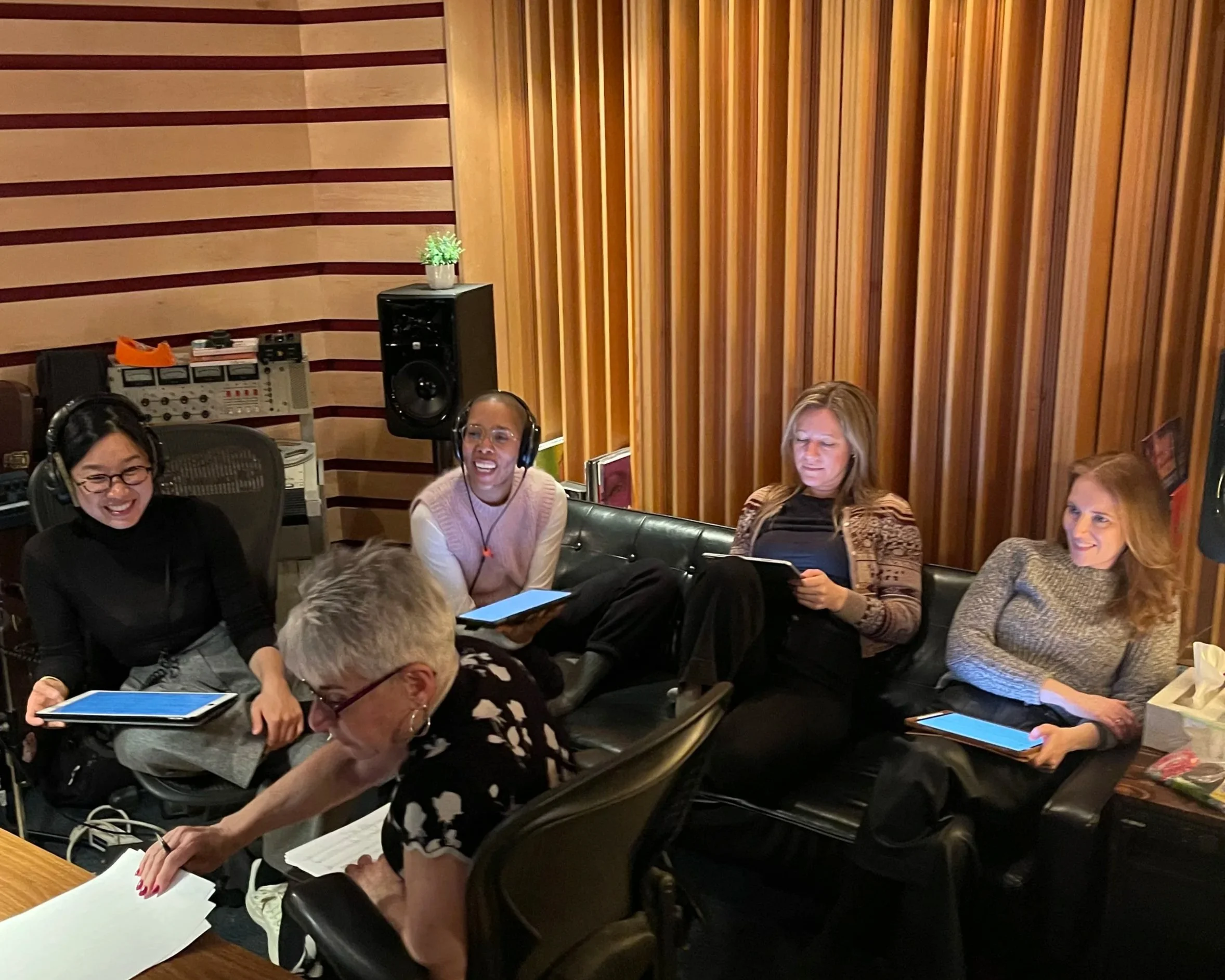
The Overlook
Based in New York City, the innovative string quartet, The Overlook, known for bold, imaginative programming, champions new compositions in the classical genre — transforming contemporary chamber music into a vivid, unforgettable experience. Praised as “breathtaking” by New York Music Daily, The Overlook features violinists Monica Davis and Yezu Woo, violist Angela Pickett, and cellist Laura Metcalf. The Overlook has appeared in performances and residencies nationwide, including recent engagements in Maryland, Oregon, New Mexico, and Tennessee. Formed during the pandemic to build community through music, the ensemble is committed to amplifying the voices of living composers and engaging audiences through performances that make contemporary chamber music both accessible and deeply compelling.
photo by Sean Davis
SHOP
ALBUM INFORMATION
Album Title: Say It
Artist: The Overlook Quartet
(Monica Davis, violin; Yezu Woo, violin; Angela Pickett, viola; Laura Metcalf, cello)
FEATURED COMPOSERS:
Trevor Weston ~ Juba
Shanan Estreicher ~ I Laughed So Hard I Cried, for Judee Sill
Shelley Washington ~ Say
Leila Adu-Gilmore ~ “if the stars align…”
Forbes Graham ~ Crossing
Carlos Simon ~ Warmth from Other Suns
-
The Overlook Quartet ~ Say It
Juba (10:06) ~ Trevor WestonI Laughed So Hard I Cried, for Judee Sill (5:39) ~ Shanan Estreicher
Say (9:50) ~ Shelley Washington
“if the stars align…” ~ Leila Adu-Gilmore
I. Shooting Stars (0:48)
II. La Terra (2:53)
III. Sirian Highlife (2:57)
Cadenza: Blue Companion Star (1:32)
IV. Digitaria (2:11)
Crossing (4:12) ~ Forbes Graham
Warmth from Other Suns ~ Carlos Simon
I. Rays of Light (6:07)
II. Flight (5:25)
III. Settle (3:20)
Recording and Production Credits
Recording Location and Date: Renaissance Recording | February 2026
Recording Producer: Elaine Martone
Recording & Mixing Engineer: Gintas Norvila
Assistant Engineer: Jenna Beaudoin
Mastering Engineer: Jennifer Nulsen
Videographer: Peter Donovan
Liner notes: Jennifer Gersten
Artwork: Forbes Graham
Art Direction & Graphic Design: Christopher Kornmann for Spit + Image
© 2026 Phenotypic Recordings
All rights reserved
LISTEN:
Phenotypic Recordings
Michael Hostetler ~ Founder
Stephen Prutsman ~ Founder & Creative Director
Cristin Canterbury Bagnall, BroadBand Collaborative ~ Fractional COO
Mary Paz Cubero Navarro ~ Director of Product Development and Strategic Partnerships
Justin J. Holden ~ Copy Editor
FEATURED COMPOSERS & THEIR WORKS
-
Juba for string quartet honors the lives and contributions of African and African American forced laborers who cultivated various crops during slavery. The work makes a musical journey from Africa to the United States through traditional African music and traditional African American folk music: fiddle music, long-meter hymns and Gullah music. Juba celebrates the musical, economic, industrial, and cultural contributions by African Americans to the United States.
-
For string quartet (+/- vocal quartet) using voice and body percussion I must have been in 1st grade or Kindergarten
when some kid said the “N” word in front of me
and I didn’t know what it meant but I wanted to find out
It kept rolling around in my head
What is it? A name? Is it a good name?
I said it out loud at home, and remember my Dad looked sad.
I must have been in 4th grade
when we had to take the Missouri Assessment Program (MAP) test
and to tell the state how smart we were
We also had to tell them what race we were
“Select One Answer” but I needed two bubbles to be honest
I asked my teacher “why can’t I fill in ‘black’ and ‘white’”
And she said “just fill in black”
and she looked sad.
In high school, I was on the swim team
My brother was on the swim team
We were both really good. We were both Varsity champions and captains.
Someone said, “I didn’t even know black people could swim”
another said, “well, you’re only good athletes because you’re black.”
I was sad.
I went to college, and was the only mixed student in the music department.
-Another time being One of The Only and this never has seemed to change even now
I played saxophone in all of the top ensembles- I was first chair bari sax in every group we had.
I earned that.
A guy I knew made black jokes all the time.
“you’re so white though”
“haha it’s just because you’re black though isn’t it?”
I slapped him across the face at a party once. Hard. I wasn’t even drinking
I was just so mad.
So mad.
I live in New York City now.
You can be whoever you want
You can be nobody
The anonymity of solitude
The fame of individuality
I love it.
Every day I’m myself.
Just a drop of creamy coffee
in the pantone of people here
I am comfortable. I am happier.
But, I read the news
I read what the things people I went to high school with are posting
And how “all lives matter” though so why are you complaining
And “well, he shoulda just listened to the cop and that wouldn’t have happened”
And needing to build a wall
And needing to take back our country
And needing to keep our guns
And needing to build up our police force
And needing to these thugs
I cry a lot when I read the news
So much hurting
Because of the bubble they’re asked to fill out on an exam form
Because someone forgot to use a turn signal
Because they “fit the description”
I can’t breathe.
I am sad.
I am black, I am white. I am both. I get to be both. I can choose. I could choose.
But who cares?
What does my mask entitle me to?
I’ve been followed around a store before
I got a DWB (driving while black) in summer once when I was really tan
A coworker said the “N” word a bunch around me but “oh, well I thought she was Mexican”
I was accused of “using the race card”
My opinions have been scrutinized
It matters to me what I feel
But it doesn’t matter- does the 1 drop rule still apply?
Some days I’d rather be totally accepted by one community and shunned by the other
instead of only partially accepted by both
not dark enough to shout it from the rooftops but not white enough to be alright either so
just another day being One of The Only
America is a big place.
A lot of people live in it.
Some people understand everyone’s pain
And some people want “the good old days” back.
We should be able to choose individually
Who we wanna be/what we want to do/how we get to live
But as of late we haven’t been able to, and it gets summarized in the headlines:
Rich White Dude Raped a Woman and Went to Jail for like 20 Seconds
Poor Black Kid was Killed for No Real Reason.
Was killed.
So what do we have to say for ourselves, hm?
What do you have to say for yourself?
What do we even say?
“liking” and hash-tagging have helped some so far
I don’t even know if God is listening – white jesus maybe but
We keep saying all these things over and over
But what’s the use? What’s the truth?
Dead horse is done beat to death more and here we are kicking away at it
so what do we do? What can we say?
So what do you have to say for yourself?
What do I have to say for myself?
What do we even say?
Say it
Say it
Say it
-
Judee Sill was an American singer-songwriter of the 1970s whose difficult life was cut short early in her career. As a composer and singer-songwriter myself, I was inspired to write this piece for The Overlook after discovering her through a New York Times "Overlooked No More" obituary. The title of my composition, "I Laughed So Hard I Cried," is taken from the final verse of Judee Sill's song "The Lamb Ran Away with the Crown." It was by drawing from this song's lyrics, vocal melody, chords, and canon-like ending that I developed the framework of my piece. Throughout, I sought to maintain a simple and honest musical language that honors the poetic vulnerability and pathos so beautifully conveyed in Judee Sill's music.
-
Written for the Brentano String Quartet. Dedicated to Michael.
This four-movement piece with a cadenza, illuminates the viola as a soloist in contrast and in conjunction with the quartet and encompasses spectral and microtonal elements (i.e. crazy tunings are intentional).
I went to see the Brentano String Quartet play in New Zealand on the invitation of Euan Murdoch, head of Chamber Music NZ. I was delighted to be able to meet the performers after the show, who kindly told me how I was going to love my upcoming time in Princeton for my composition PhD. Misha Amory, the viola player, said to me: "If the stars align, you will write for us." When I arrived at Princeton, the due date of 12/12/12 was also my birthday, so this piece took on some cosmic proportions to do with the numbers 12 (which is 3 in numerology) and 4, which is connected to the date. On rhythm: although I am a kiwi, my father is from Ghana and I added some Ghanaian highlife themes and polyrhythms; also playing on the 3 against 4 theme. Moreover, due to all of this stellar activity, I decided to make the viola the protagonist amongst the 4 players, contrasting, colliding and coming together with the other three players...
-
Dedicated to Jesse Redmon Fauset Crossing was conceived as a representation of waves and probabilities. Those waves interact with each other, intersecting as sound does, and as we do in the world. Around the time that I wrote the piece, I also made a painting with the same title. The painting was primarily composed of a limited set of gestures. The painting more readily proposes another meaning — a border. The tension between borders and crossing them, sight and sound, and between different forms of observation and understanding presented themselves to me within this piece. In certain ways, the painting Crossing, symbolized the challenges and problems of living in a world with borders. The string quartet Crossing, showed me the possibilities of cooperation and comity.
-
Warmth from Other Suns is a terrifying expression of the duality of wanting to find rest, yet never being able to call a place home. This musical journey is based off of the thrilling book, The Warmth of Other Suns by Pulitzer Prize novelist, Isabel Wilkerson. Wilkerson’s book describes the Great Migration where many African Americans fled from southern states which were filled with the hot stench of Jim Crow. The Great Migration would take them to a new part of America where the promise of more economic opportunity hung before them with wavering uncertainty. The author centers the story around three main characters. My aim was to embody the feelings of the main characters and express their spirit musically. Program note by Leah Claiborne. Initially commissioned by the Sphinx Organization, Vermont Symphony, and the Red Shoe Company.