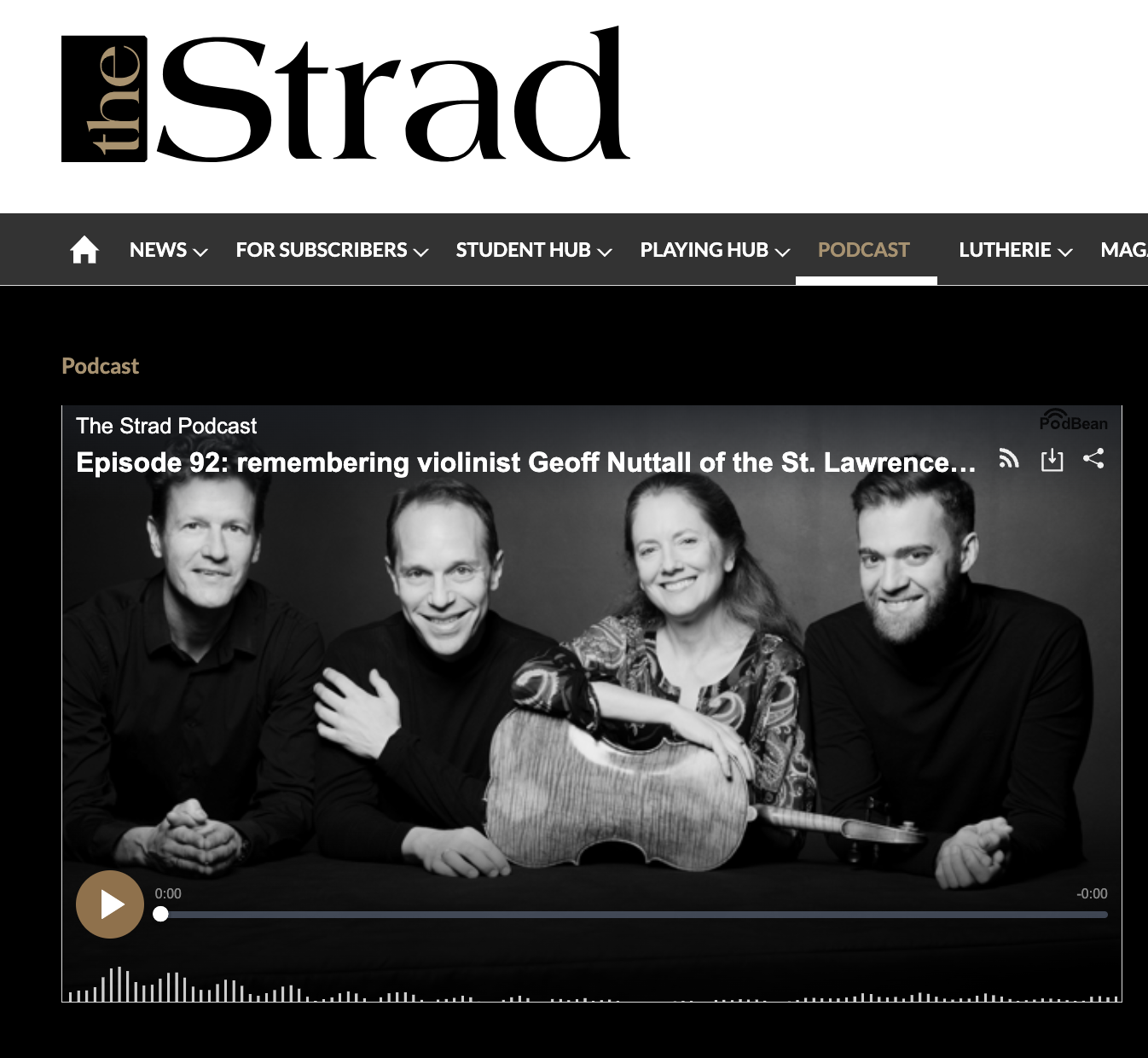
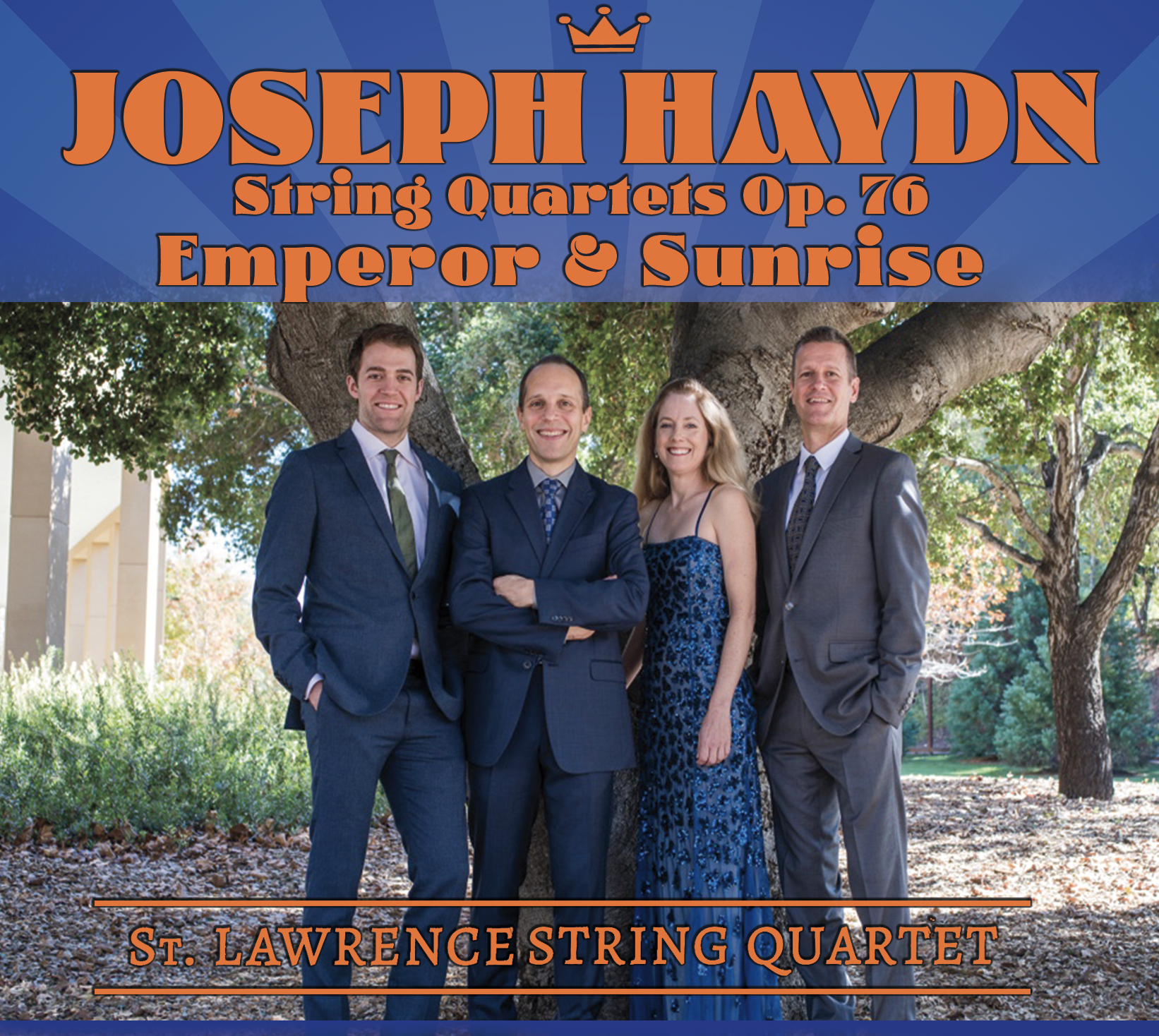
ST. LAWRENCE STRING QUARTET
Erich Wolfgang Korngold Piano Quintet in E major

This exuberant EP is one of two not-to-be-missed farewell albums from the beloved St. Lawrence String Quartet. Go for a ride with SLSQ in this wild fantastical journey by Erich Wolfgang Korngold.
SLSQ’s celebrated founding violinist Geoff Nuttall passed away in 2022 from pancreatic cancer. Phenotypic Recordings will donate all proceeds from this album to the Geoff Nuttall Memorial Fund for cancer research at Stanford University.
LISTEN




ST. LAWRENCE STRING QUARTET
“Modern,” “dramatic,” “superb,” “wickedly attentive,” “with a hint of rock 'n roll energy” are just a few ways critics describe the musical phenomenon that is the St. Lawrence String Quartet (SLSQ). The SLSQ is renowned for the intensity of its performances, its breadth of repertoire, and its commitment to concert experiences that are at once intellectually exciting and emotionally alive.
Founded in Toronto in 1989, the SLSQ were renowned for their high-energy, deeply expressive, and “take no prisoners” approach to all music, and beloved for nurturing an engaged and inclusive musical community. As Alex Ross of The New Yorker aptly noted, “the SLSQ is remarkable not simply for the quality of their music-making, exalted as it is, but for the joy they take in the act of connection.”
Well-known for performing a broad and eclectic repertoire, SLSQ were especially regarded for their commitment to the music of Haydn and new music.
Album Information
COMPOSER: Erich Wolfgang Korngold
TITLE: Piano Quintet in E Major Op. 15
ARTISTS: St. Lawrence String Quartet (Owen Dalby, violin; Geoff Nuttall, violin; Lesley Robertson, viola; Christopher Costanza, cello)
SUMMARY: The show-stopping farewell album from the beloved St. Lawrence String Quartet,
CREDITS: Recorded at Bing Concert Hall in Stanford University, December 14 and 15, 2021 | Produced and Engineered by Mark Willsher | Album design by Aryahi Naomi Onaga | Cover photo by Eric Cheng
MUSIC WITH A MISSION: Phenotypic Recordings will donate all proceeds to the Geoff Nuttall Memorial Fund for pancreatic cancer research at Stanford University
-
I. Mäßiges Zeitmaß, Mit Schwungvoll Blühendem Ausdruck
II. Adagio. Mit Größter Ruhe, Stets Äußerst Gebunden Und Ausdrucksvoll
III. Finale. Gemessen, Beinahe Pathetisch
-

This album [together with Haydn Emperor & Sunrise] mark the end of an era for the St. Lawrence. They were recorded in December of 2021 at Stanford's Bing Concert Hall shortly after Geoff Nuttall received a devastating cancer diagnosis. A few months later, he was gone.
We are forever grateful to have had the opportunity to come together one last time with our dear friend Stephen Prutsman for this performance of Korngold’s monumental Piano Quintet —-a deeply meaningful final collaboration representing thirty years of friendship.
— St. Lawrence String Quartet

A lush, emotionally vast “epic journey”
The extraordinary 20th Century Austrian composer Erich Wolfgang Korngold stunned the world as a child prodigy, achieved international fame as a young man in the 1920s, emigrated to the United States after already having established himself as the father of the classic Hollywood movie soundtrack and ultimately left a small but breathtaking oeuvre of concert music. But with the radical shifts in politics, culture and taste following two world wars, the ferocity of the postwar avant-garde, and the misapplied stigma of “selling out”, Korngold’s reputation tanked. If he was not ridiculed or disdained as anachronistic or opportunistic, he was utterly forgotten as irrelevant. It was only towards the end of the 20th Century amidst a return to tonal and Neo-Romantic music, that Korngold was rediscovered, first through highlights of his magnificent film scores and then, approaching the centennial of his birth in 1997, through his “serious” instrumental music. Now well into the 21st Century, one encounters Korngold’s masterful and completely original music on concert programs again featuring, especially, a trove of outstanding chamber music.
A 24-year-old Korngold penned his op.15 piano quintet during a high point in his early career: 1920 saw the premiere of his most famous opera Die tote Stadt (The Dead City) that became one of the most popular internationally staged operas of the 1920s. After working on a big theatrical work, Korngold would often relax by composing chamber music and he started at once with the first of three string quartets (to be completed a few years hence) as well as the piano quintet (which he completed first, in 1921, and successfully premiered as the pianist in 1923). It is a perfect showcase for Korngold’s literally fantastic music, a unique, nearly unclassifiable style characterized nonetheless by trademark features.
With the opening bars of the first movement, we hear Korngold’s grand late-Romantic style, lush, lyrical and almost always tonal. But soon and essentially throughout, he defies convention and expectation, surprising with daring harmonies, modulations (key changes), chromaticism (the smallest intervals more granular than melody) and dissonance. The emotional range within a single movement is astonishingly vast as is the ever-shifting texture including individual and composite sonorities redefining the “sound” of the piano quintet right before our very ears. The music teems with a wealth of themes, motives with a density of invention that nearly overwhelms as it delights. But this is not mere fantasy or pastiche: an heir of the Viennese masters, Korngold generates his musical fabric from a small set of motifs made rich through constant variation. It is an epic journey between the first sweep of the main theme and its symmetrical echo towards the end with a myriad of permutations along the way.
With the opening bars of the first movement, we hear Korngold’s grand late-Romantic style, lush, lyrical and almost always tonal. But soon and essentially throughout, he defies convention and expectation, surprising with daring harmonies, modulations (key changes), chromaticism (the smallest intervals more granular than melody) and dissonance. The emotional range within a single movement is astonishingly vast as is the ever-shifting texture including individual and composite sonorities redefining the “sound” of the piano quintet right before our very ears. The music teems with a wealth of themes, motives with a density of invention that nearly overwhelms as it delights. But this is not mere fantasy or pastiche: an heir of the Viennese masters, Korngold generates his musical fabric from a small set of motifs made rich through constant variation. It is an epic journey between the first sweep of the main theme and its symmetrical echo towards the end with a myriad of permutations along the way.
The second movement highlights another Korngold specialty: an emotional slow movement, a song without words as deep as a dream. As he would do many times, Korngold borrows from his own songs, in this case as he notes in the score, “a free variation on ‘Songs of Farewell’, Op. 14.” Korngold composed these lieder almost simultaneously in 1920-21 and uses especially the theme from the beautiful third song (“Moon, thou riseth again”) for a rather miraculous set of nine numbered variations that flow seamlessly in a long unbroken line traversing a single dramatic arc. Korngold’s score is meticulously and densely notated with constantly changing time signatures, articulations and mood indicators for a finely nuanced Romantic rapture.
The last movement switches gears yet again for a vibrant and ingenious rondo finale with the spirit and wit of the best Viennese masters, but with an inexhaustible Korngoldian fecundity and the occasional “crunch” of early modern music. Novel textures and sonorities abound once again, as do brilliantly wrought chamber music textures and a variety of counterpoint including little fugues, as well as multiple, independent tunes, layered on top of each other simultaneously. The main theme, a motivic gesture, seems like it was extracted from the tail of the first movement’s theme and towards the end, it morphs into its longer progenitor as the end recalls the very beginning. Throughout it all, there is a kind of dazzling magic and breathless wonder that is the essence of Korngold’s music.
~ Kai Christiansen
© Kai Christiansen Used by permission. All rights reserved.