Photo: Anneli Ivaste
KAREEM ROUSTOM
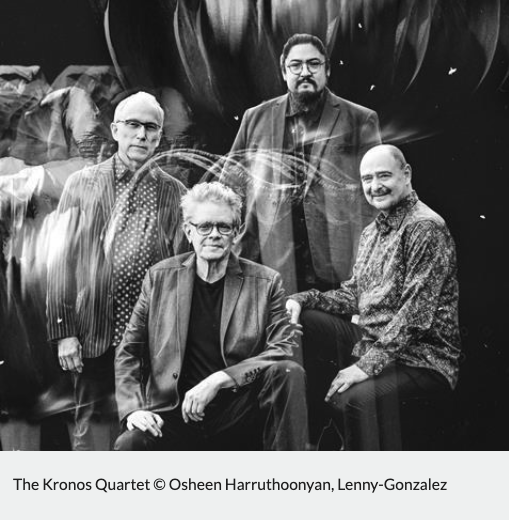
Syrian-American Kareem Roustom is an Emmy-nominated composer whose genre-crossing collaborations include music commissioned by conductor Daniel Barenboim and the West-Eastern Divan Orchestra, the Kronos Quartet, arrangements for pop icons Shakira and Tina Turner, and collaboration with acclaimed British choreographer Shobana Jeyasingh. Most recently, Roustom continued his collaboration with the Grammy award winning Estonian conductor, Tonu Kaljuste, and the renowned Estonian Philharmonic Chamber Choir.
Roustom has been composer-in-residence at the Grant Park Music Festival in Chicago, the Grand Teton Music Festival in Wyoming, and with the Württembergische Philharmonie Reutlingen and the Mannheim Philharmonic in Germany. A musically bilingual composer, Roustom is rooted in the music of the Arab Near East, but his music often expresses beyond the confines of tradition. The themes of a number of his works touch issues of those affected by war and instability.
Roustom’s music has been performed by ensembles including the BBC Symphony Orchestra, Rotterdam Philharmonic, Minnesota Orchestra, NDR Elbphilharmonie Orchester, Estonian Philharmonic Chamber Choir, Boston Symphony Orchestra, San Francisco Symphony Orchestra, New York Philharmonic, Cincinnati Symphony Orchestra, Pittsburgh Symphony, Boulez Ensemble, Oregon Symphony, Orchestre Symphonique de Mulhouse, The Crossing choir, Lorelei Ensemble, A Far Cry, and at renowned festivals and halls such as the BBC Proms, the Salzburg Festival, the Lucerne Festival, Carnegie Hall, the Verbier Festival, the Pierre Boulez Saal in Berlin, the Teatro Colon in Buenos Aires, and others. www.kr-music.com

Kareem Roustom Latest News:
On May 16th, 2026 the renowned Estonian Philharmonic Chamber Choir and the Tallinn Chamber Orchestra gave a concert of Roustom’s music in Tallinn, which included two world-premieres. After the concert, Roustom spent six days recording this program for an album of his music. He also played Oud on one of the pieces.
In the fall of 2026, Roustom will be recording an album of his music with Grammy-nominated Palaver Strings which will also include a new work that Roustom composed in the summer 2026, for Oud and string orchestra.
Roustom’s music will be featured on two other albums releasing in 2026: a solo piano album featuring his Aleppo Songs, and a clarinet quintet album featuring his Palestinian Songs & Dances.
In March 2026, Roustom recorded his Oud Quintet with Apple Hill String Quartet. This album will be released in May of 2027 and features a large work by Meredith Monk.
Roustom is also currently writing a new solo piano work for Garrick Ohlsson who will premiere it in February 2027 at a festival in Nappa Valley.
“Music can allow for an understanding that human beings are all bonded. If we recognize and affirm the humanity in others, we then affirm our own humanity.”
- Kareem Roustom
Hopes and visions of a better world
“While reflecting on a tumultuous time for our planet, these works seek not only to express the anguish so palpable in this moment, but to find a grounding solace. For me, this was achieved through exploring ways to balance the musical traditions of my native Syria with the musical languages and experiences of my many years as an American composer. This hyphenated existence, which was at first a burden, has now become a creative spring from which I drink often. Musical and personal memories provided a point of departure from which many of these chamber works were crafted. Ultimately, this creative act provided the light that cut through the darkness of our moment…
The inspirations for these compositions include nature, contemporary and folk dance, church hymns, folk songs, and poetry, as well as Western opera, of or about the Near East… This music is a natural expression of my multifaceted identity and varied interests, but is also my hope that this music may help people from the Arab world and the ‘Western’ world to better understand each other. Though both are comprised of a beautifully dazzling variety of cultures, religions, and complex histories, there is a shared humanity. Just as I found inspiration in both Monteverdi’s music and Iraqi folk dance for my Four Dances from Clorinda Agonistes, I hope that music lovers from both regions might also make that connection. It is also my hope that the creation of these compositions can build a repertoire for young musicians of Western classical music of the Levant or its diaspora, that allows them to feel the transcendent experience of playing their instrument in music that reflects part of themselves, their families, and their history.
This creative act has now also become an act of resistance against the second iteration of a callous and willfully ignorant American regime that is bent on silencing any artistic or cultural voice that does not fit into its narrow and racist definition of ‘American culture.’ Authoritarian regimes throughout history have sought to suppress artists, because artists are at the forefront of free expression—the linchpin of democracy—giving form to the sentiments of people, as well as voicing hopes and visions of a better world. Ethnic, racial, religious, and cultural minorities have always been specially targeted; to strip them of their cultural inheritance is a way to make them invisible and silent, and to eventually eradicate them.
Despite this, artists are still creating and making their voices heard, in the United States and abroad… It is the spirit of community, and collaboration, that envelops all these works, and that ultimately gives meaning to the creative act. It gives me great hope for the world that I have found so many supporters of this endeavor.”
~ Kareem Roustom
Read more in Artist Notes
VIDEO: Interview with Kareem Roustom

SHADES OF NIGHT
featuring
Balourdet Quartet
EmmaLee Holmes-Hicks & Piero Guimaraes
A exquisite collection of new works by acclaimed Syrian-American composer Kareem Roustom, Shades of Night is a thrilling exploration of Near Eastern themes with “Western” instrumentation, including rare opportunities to experience Palestinian and Iraqi folk songs in the language of string quartet, as well as Western opera reimagined alongside contemporary Near Eastern themes.
Playing with boundaries of time, space, and culture and transcending them, this musical poetry unites past and present, East and West ~ allowing us to easily recognize our common humanity.